
Water Scarcity and Stress Levels - Pakistan
Pakistan is facing an acute water crisis, rapidly transitioning from a "water-stressed" to a "water-scarce" nation. Per-capita annual water availability has plummeted from 1,500 cubic meters in 2009 to 1,017 cubic meters, teetering on the absolute scarcity threshold of 1,000 cubic meters.
Primary Water Sources in Pakistan
- The Indus River System: Accounts for 95.8% of Pakistan's total renewable surface water resources. Over 78% of this water originates outside national borders.
- Glacial Melt: The Karakoram and Himalayan mountain ranges house over 7,253 glaciers. This glacier network feeds roughly 75% of the country's stored water supply.
- Groundwater (Indus Basin Aquifer): Pakistan is the world's fourth-largest groundwater extractor. Ground aquifers supply 73% of irrigated fields.
- Rainfall: Driven by monsoon cycles, Pakistan's annual rainfall remains below the global average and is highly variable and seasonal.
Current Water Scarcity & Stress Levels
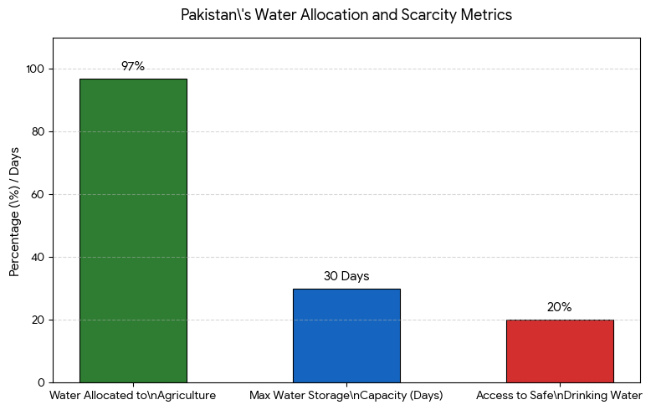
30 daysMaximum water storage capacity
97%Approx. water consumed by agriculture
20%Population with access to safe drinking water
- 30-Day Storage Capacity: Pakistan can only hold a maximum 30-day supply of water, compared with the 120-day international benchmark stated in the source content.
- Water-Intensive Economy: The country exhibits the 4th highest rate of water use globally; agriculture consumes roughly 97% of available surface and groundwater resources.
- Urban Scarcity Hotspots: Karachi, Lahore, Quetta, Rawalpindi, and Faisalabad face absolute scarcity.
- Drinking Water Crisis: Only 20% of the population has access to safe drinking water. The remaining 80% rely on water contaminated by sewage, industrial effluents, and agricultural run-off.